
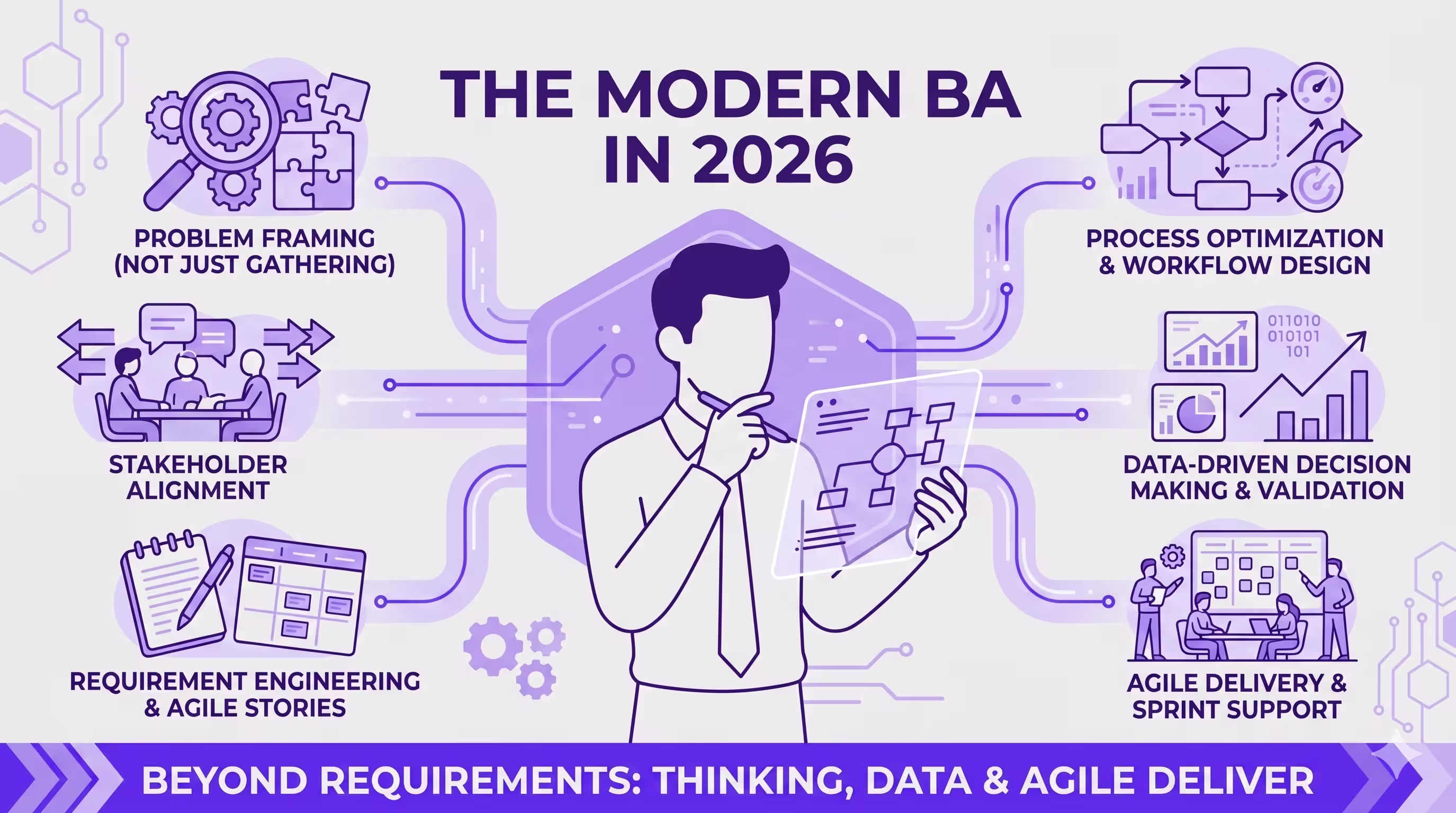
What Is a Business Analyst? Roles, Types & What They Actually Do in 2026
After more than a decade of bridging the gap between business problems and technical solutions, I’ve watched the BA role transform dramatically and I want to cut through the noise and tell you what it genuinely means in 2026.
Everyone has a slightly different answer when you ask what a Business Analyst actually does. Your manager says “requirements.” Your dev team says “the person who gives us tickets.” A recruiter says “strategic partner.” They’re all partially right and that ambiguity is exactly what makes the role both fascinating and frequently misunderstood.
The honest definition
A Business Analyst is someone who identifies business problems, understands them deeply enough to articulate them clearly, and works with stakeholders and technical teams to deliver solutions. That’s it at the core. Everything else the frameworks, the tools, the methodologies is scaffolding around that central act.
“The BA is the person in the room who keeps asking ‘why’ until everyone understands what problem we’re actually solving not just the one they thought we were solving.”
In practice, this means spending a lot of time in conversations. Listening to a VP talk about declining conversion rates. Sitting with a warehouse team watching how they actually process orders (which is never quite how the process documents describe it). Reading between the lines of what people say versus what they mean. Then translating all of that into something actionable for engineers, designers, and leadership.
The different types of Business Analyst
The “BA” label covers a surprisingly wide range of specialisations. In 2026, here are the most common paths you’ll encounter:
IT / Systems BA Works on technology transformation, software implementations, and system integrations.
Data BA Focuses on data quality, reporting pipelines, BI tools, and turning data into business decisions.
Process BA Maps, analyses and redesigns business processes often in ops, supply chain, or finance.
Agile / Product BA Embedded in product squads, writing user stories, managing backlogs, running sprint ceremonies.
Functional BA Domain expert (finance, HR, supply chain) who bridges business rules with software configuration.
AI / Automation BA Emerging role identifying where AI and automation can be applied and governing how they are.
Early in my career I was a pure IT BA. Over the years I’ve worked across process and data domains too. Most experienced BAs end up as generalists with one deep specialism which is exactly the shape the market rewards.
What a BA actually does daytoday
People outside the role often imagine BAs writing documents all day. The reality is far messier, more social, and honestly more interesting than that.
Discovery & stakeholder interviews Before a single requirement is written, you spend time understanding the problem landscape. This means structured interviews, workshops, shadowing teams, and reviewing existing documentation (which is usually wrong or outdated).
Requirements elicitation & documentation Translating what stakeholders need into structured artefacts user stories, use cases, process maps, data dictionaries, acceptance criteria. The format depends on the project and team.
Process modelling Drawing ASIS and TOBE process flows using tools like Lucidchart, BPMN, or Miro. You’re making invisible workflows visible and negotiating what they should look like.
Backlog management & grooming In agile environments, keeping the product backlog prioritised, refined, and properly sized is a significant chunk of a BA’s week. This involves constant negotiation between business value and technical effort.
UAT coordination & signoff Working with business users to define test scenarios, track defects, and ensure what was built actually solves the original problem not just technically passes tests.
Change management support Often underrated. BAs are frequently the ones helping teams understand and adapt to what’s changing, writing training materials, and managing communications.
The skills that actually matter in 2026
The job has changed more in the last three years than in the previous seven. AI tools have automated the grunt work of documentation. What’s left is the hard stuff that machines can’t replicate well yet.
The skills that matter most, in order: stakeholder management, critical thinking, process modelling, data literacy and basic SQL, agile and scrum, and AI tool proficiency. Notice that the top two are human skills, not technical ones. That’s not a platitude it genuinely is the job.